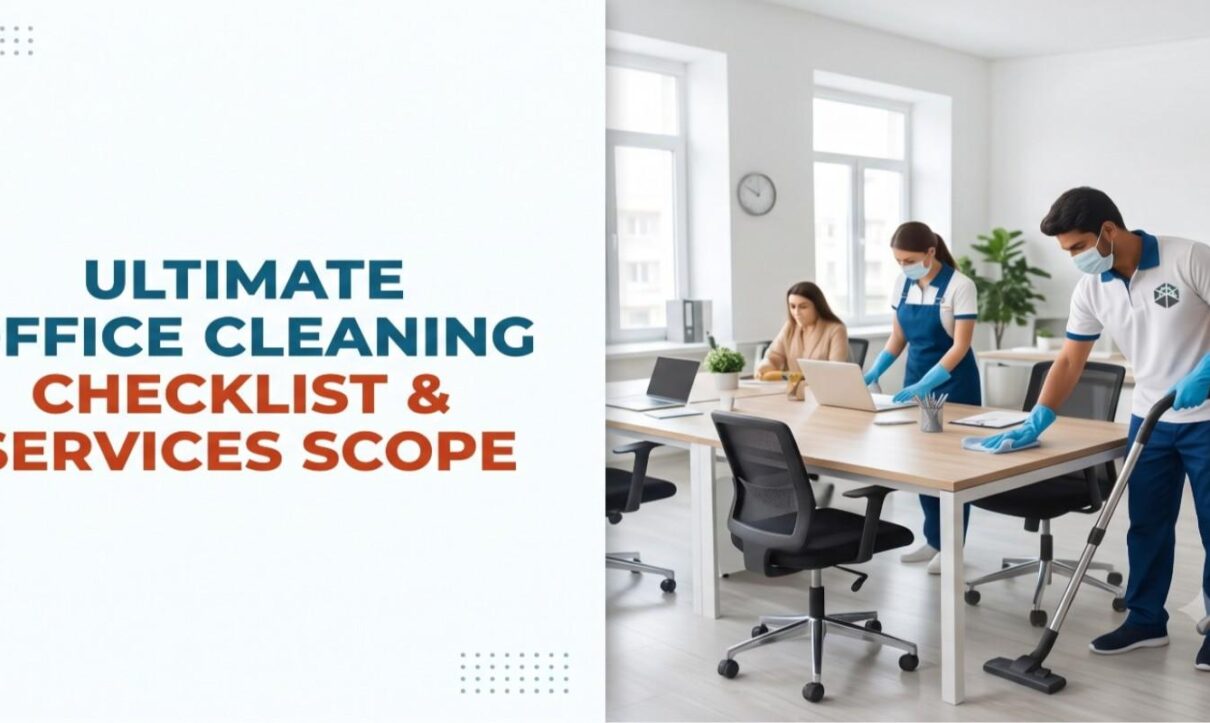

Safaiwale Expert Guides: Practical, no-fluff cleaning protocols for businesses and commercial spaces.
Most complaints about a “dirty office” rarely have anything to do with the daily cleaner missing a minor spot. Instead, they stem from an entire tier of deep work—the weekly and monthly tasks—that nobody scheduled in the first place.
A professional commercial office cleaning checklist is built in three distinct layers: daily tasks (trash, desks, floors, restrooms), weekly tasks (deep vacuuming, glass, kitchen equipment), and monthly tasks (high dusting, window cleaning, floor treatments). Whether you manage an in-house janitorial team or are looking to hire outsourced corporate cleaning services, this guide breaks down exactly what should be happening in your workspace.
Table of Contents
- What does commercial office cleaning actually include?
- The Daily Office Cleaning Checklist
- The Weekly Maintenance Checklist
- The Monthly Deep Cleaning Checklist
- Customizing the Checklist for Your Industry
- Signs Your Current Cleaning Contract is Failing
- What standard contracts usually exclude
- Health, Safety, and the ROI of a Clean Office
- Frequently Asked Questions
What does commercial office cleaning actually include?
“Office cleaning” is a broad umbrella term, meaning vastly different things to different vendors. This ambiguity is exactly why billing disputes happen. In practice, a proper commercial cleaning scope maps tasks across three frequency tiers. A vendor quoting a surprisingly low single flat rate is usually only budgeting for the daily tier. Consequently, monthly deep-cleaning tasks get quietly ignored until the office starts looking visibly degraded.
Daily Office Cleaning Checklist
These are the foundational tasks required to keep an office functional, hygienic, and presentable for staff and clients on a day-to-day basis.
| Area | Task Requirements |
|---|---|
| Reception & Common Areas | Sweeping and mopping (or vacuuming) all floor surfaces |
| Wiping down reception desks and seating surfaces | |
| Cleaning glass entry doors and removing visible fingerprints | |
| Emptying and relining general waste bins | |
| Workstations & Desks | Wiping desk surfaces (safely navigating personal items) |
| Spot-cleaning visible marks on chairs and desk partitions | |
| Emptying individual under-desk bins | |
| Vacuuming carpeted walkways and high-traffic open areas | |
| Restrooms | Deep cleaning and disinfecting toilets, urinals, and sinks |
| Restocking soap, tissue, and hand towels | |
| Wiping mirrors and mopping floors with a heavy disinfectant solution | |
| Checking and safely emptying sanitary bins | |
| Pantry / Kitchenette | Wiping counters, sinks, and dining tables |
| Wiping down the exterior of shared appliances (fridge, microwave, coffee maker) | |
| Segregating recyclables and replacing heavy-duty liners |
Weekly Office Cleaning Tasks
Weekly tasks move beyond surface tidiness to address the steady buildup of dust, grime, and bacteria that daily cleaning simply doesn’t have the time to reach.
| Task | Why it’s on a weekly cycle |
|---|---|
| Deep vacuuming carpets, including under movable furniture | Daily vacuuming misses trapped dust and debris underneath desks. |
| Cleaning glass partitions, cabin doors, and interior windows fully | Full-panel streak-free cleaning takes dedicated time beyond daily smudge wipes. |
| Disinfecting shared equipment (printers, phones, door handles) | High-touch surfaces require regular chemical disinfection to prevent illness spread. |
| Cleaning inside kitchen appliances (microwave plates, fridge shelves) | Food splatters and interior buildup happen gradually and require deeper scrubbing. |
| Dusting blinds, window sills, and baseboards | Dust settles into these low-visibility areas slowly throughout the week. |
Monthly Office Cleaning Tasks
Monthly (or quarterly) tasks target areas that don’t show wear immediately, but will noticeably age and degrade a workspace if ignored for an extended period.
| Task | Why it’s on a monthly cycle |
|---|---|
| High dusting: ceiling corners, exposed beams, top of cabinets | Requires ladders or extension tools; poses a safety hazard if rushed daily. |
| Light fixture and ceiling vent dusting | Prevents dust from circulating through the HVAC system over time. |
| Deep floor treatments (scrubbing, polishing hard floors, carpet extraction) | Restores the flooring material’s protective coat rather than just maintaining the surface. |
| Vacuuming upholstered chairs and reception seating | Extracts embedded allergens, dead skin, and dust buildup from fabrics. |
Customizing the Checklist for Your Industry
A standard corporate checklist is a great starting point, but different industries face unique hygiene challenges. Ensure your vendor is adapting their protocols to fit your specific operational needs:
- Tech & IT Offices: Require anti-static cleaning methods for server rooms and careful navigation around complex cable management under workstations.
- Medical & Dental Clinics: Must adhere to strict biomedical waste disposal guidelines and use hospital-grade disinfectants on all high-touch surfaces, waiting room chairs, and front desks.
- Creative Studios: Often feature open floor plans and polished concrete or hardwood floors, requiring specialized buffing and low-moisture cleaning to protect expensive architectural finishes.
The Color-Coded Standard: Regardless of your industry, a professional cleaning company should always use a color-coded microfiber system. This means using separate colored cloths for restrooms (e.g., red), pantries (e.g., green), and general desk areas (e.g., blue) to completely eliminate the risk of cross-contamination.
Need a checklist tailored exactly to your office layout?
Stop guessing what you need. We’ll map out a precise frequency schedule specific to your floor count, foot traffic, and industry—completely free.
Signs Your Current Cleaning Contract is Failing
If you already have a commercial cleaner but are experiencing complaints from staff, the issue is likely a gap in the Service Level Agreement (SLA). Look out for these three major red flags:
- The “Surface Swipe”: Desk surfaces are wiped around keyboards and monitors, but coffee rings under mugs are left untouched.
- Restroom Supply Shortages: If your staff frequently reports empty soap dispensers or lack of paper towels by 2:00 PM, your vendor’s daily scope is inadequate.
- Odors in the Pantry: Lingering smells near the breakroom usually mean the microwave interior and the rubber seals on the refrigerator are being ignored during weekly cleans.
What a standard cleaning contract usually excludes
Just as important as knowing what is included is knowing what is explicitly excluded. These items are the most common source of “I thought that was covered” disputes and are almost always billed as separate line items.
| Not Included | Why it’s a separate line item |
|---|---|
| Deep carpet shampooing | Periodic add-on requiring specialized heavy machinery. |
| Pest control | A separate service requiring specific chemical licenses and an AMC. |
| Exterior building or facade cleaning | Requires scaffolding, boom lifts, and high-altitude safety certifications. |
| IT & Server Room deep cleaning | Requires anti-static equipment and specialized training to avoid damaging hardware. |
Health, Safety, and the ROI of a Clean Office
Viewing commercial cleaning purely as an operational expense is a mistake. A rigorously maintained office directly impacts the bottom line through reduced sick days and improved employee morale. Furthermore, modern businesses are increasingly adopting Green Cleaning Standards. By ensuring your vendor uses eco-friendly, low-VOC (Volatile Organic Compound) cleaning agents equipped with HEPA-filter vacuums, you drastically improve indoor air quality, reducing afternoon fatigue and respiratory irritation among your staff.
Frequently Asked Questions
What should I ask a cleaning vendor before signing a contract?
Always ask for a written task breakdown by frequency (daily/weekly/monthly). Confirm whether consumable supplies (toilet paper, soap) and equipment are included in the rate, ask exactly how many staff-hours each visit covers, and request an explicit list of exclusions to avoid surprise billing.
What is the difference between daily cleaning and deep cleaning?
Daily cleaning focuses on basic hygiene and tidiness (trash removal, surface wiping, restroom sanitization). Deep cleaning addresses long-term buildup (carpet shampooing, upholstery extraction, high-altitude dusting, and hard floor polishing). Deep cleaning is usually scheduled quarterly or bi-annually.
Does standard office cleaning include restroom restocking?
Yes, physically restocking the dispensers is a standard daily task. However, purchasing the consumables (the actual soap and paper towels) is often a separate line item. Always clarify with your vendor if they provide the inventory or if you need to supply it.
How often should office cleaning actually be done?
This depends heavily on footfall. A standard corporate office of 20-50 people usually requires daily common-area cleaning. However, a 24-hour co-working space might require multiple porter shifts a day, while a small, low-traffic creative studio might only need cleaning three times a week.
Ready to upgrade your workspace hygiene?
Get a fast, no-obligation estimate based directly on your square footage and current cleaning gaps.